1. Introduction: from standardisation to the consumer's psychological game
Within the architecture of today's experience economy, consumer behaviour is no longer driven purely by the rational maximisation of utility — it is deeply shaped by underlying psychological mechanisms, neurochemical responses, and cognitive biases. The restaurant industry, as a frontline of the experience economy, is often where these psychological shifts surface first — in menu design and service formats. Two seemingly opposite formats — "blackboard specials" (off-menu items) and "à la carte" — have shown remarkable resilience and popularity. They are not merely the byproducts of inventory management or pricing strategy; they precisely target the human brain's primal cravings for "scarcity," "novelty," "autonomy," and "reward prediction."
This report draws on both behavioural economics and neuroscience to dissect why blackboard specials and à la carte have such enduring appeal. We use the dopamine reward-prediction-error (RPE) framework to explain why "uncertainty" and "discovery" can deliver more pleasure than the substance itself; we then apply mental accounting and the IKEA effect to explore how autonomous choice rewires perceived value. To test the universality of these mechanisms, the report crosses industry borders, drawing analogies between restaurants and hospitality (pop-up hotels, hidden facilities) and entertainment (Easter-egg culture, customised content). Finally, we explore how to combine these insights with Daniel Kahneman's Peak-End Rule, giving operators a neuroscience-grounded framework for experience design — turning short-term consumption impulses into long-term brand memory and loyalty.
2. The psychology of blackboard specials and hidden menus: scarcity, signalling, and the hunting instinct
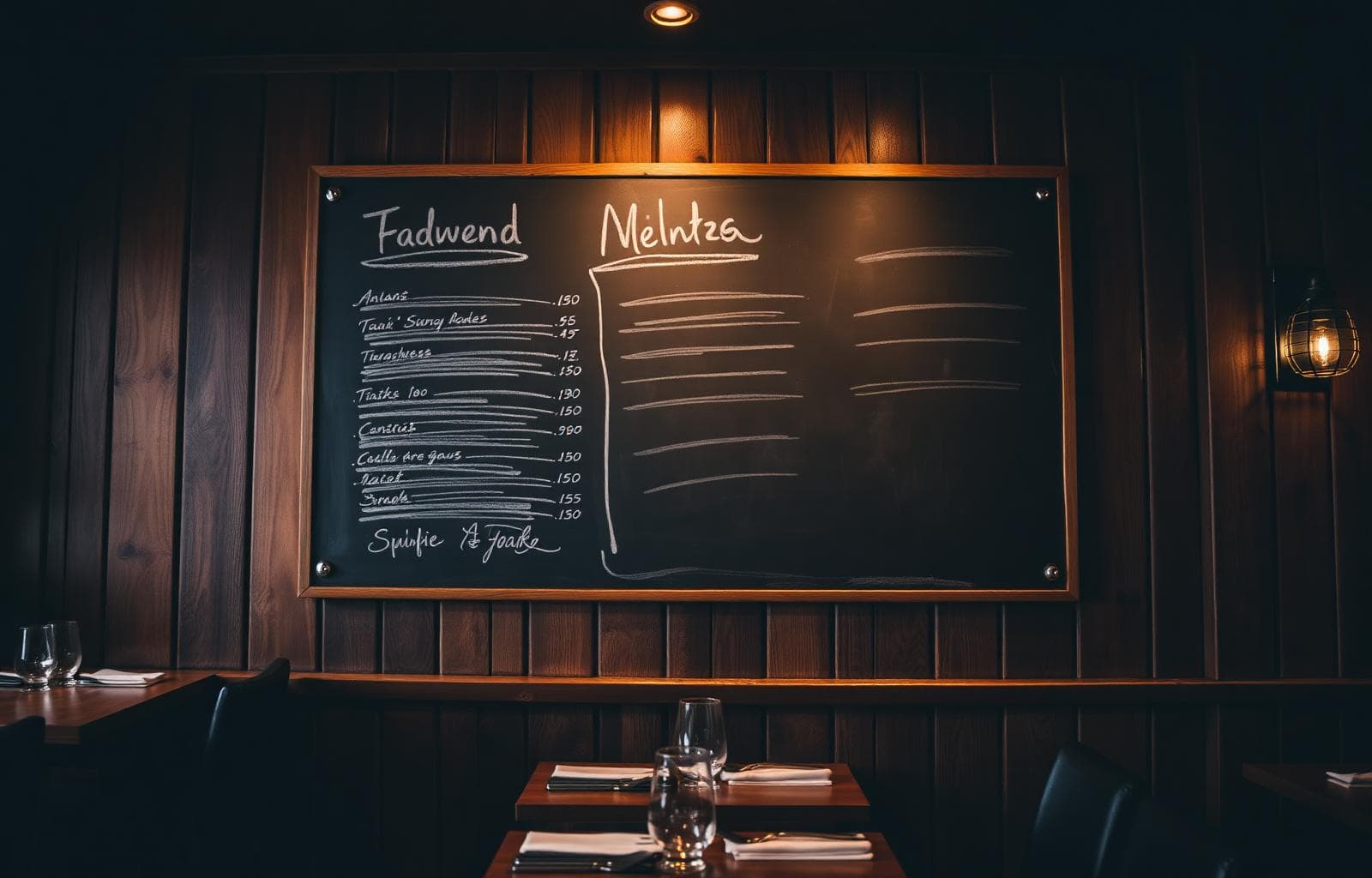
"Blackboard specials" or "chef's selections" usually take the form of handwritten daily picks on a chalkboard — sometimes nothing is written down at all, with the secret menu travelling only by word of mouth. This non-standardised presentation triggers a powerful chain of psychological and neural responses.
2.1 The scarcity effect and Commodity Theory in practice
Scarcity is one of the strongest drivers of human behaviour. Brock's Commodity Theory holds that the perceived value of any good rises when its availability is constrained. A blackboard special is, at heart, a "limited supply" signal — implying availability is constrained by today's ingredient sourcing or the chef's inspiration; this uncertainty creates a psychological premium on value.[1] [2] [3]
When a diner reads "today's air-flown ruby snapper" or "seasonal white-truffle risotto" on a chalkboard, the brain's fear centre — the amygdala — reacts to potential loss. This is the Fear of Missing Out (FOMO). Psychological research shows that loss aversion makes the pain of "losing an opportunity" roughly twice as intense as the pleasure of "gaining the same benefit." So, to avoid the post-decision regret of "next time it won't be here," the diner generates strong urgency, bypasses rational price comparison, and moves directly to the purchase. That is why blackboard specials often sell at higher gross margins — within a scarcity frame, price sensitivity is markedly suppressed.
2.2 The psychology of handwriting: authenticity and de-industrialisation
In an era saturated with digital menus and glossy print, handwriting itself becomes a powerful psychological signal. Semiotically, print connotes standardisation, industrialisation, and reproducibility — often associated with frozen food, central kitchens, and soulless chains. Handwriting, by contrast, conveys "the human touch," "immediacy," and "fluidity."[4]
When a guest sees a slightly hurried scrawl on a chalkboard, the brain runs a heuristic inference: this dish was written by the chef in person, which means the ingredients may have just arrived, or it is the chef's special pick of the day. This perceived "authenticity" builds trust. Research shows over-stylised or blurry food photos reduce trust, while simple text combined with handwriting actually leaves more room for the consumer's imagination. That "blank space" forces the consumer's brain to use simulation to construct a delicious image of the food — an active cognitive engagement that pre-strengthens anticipation and affinity. Blackboard sectioning ("chef's pick," "today's special") also acts as a "nudge" in cognitive psychology — directing attention toward high-margin or talkable items and reducing the friction of decision fatigue.[5]
2.3 Social signalling and the insider's superiority
The logic of off-menu items goes a step further into status signalling, a concept from social psychology. When a guest, in front of others, orders a dish not on the menu, or asks the server "what's special on the board today," that is not merely a purchase — it is a social performance. The behaviour signals to tablemates and observers that this person is a "regular" or a "connoisseur" with information advantage that ordinary people lack.
This "insider" feeling is intensely rewarding. According to social comparison theory, people derive self-worth from comparison with others. Being able to order off-menu means breaking through the standardised service frame and securing a privilege. This exclusivity and superiority is the key to why blackboard specials and hidden menus drive high customer stickiness. Consumers are no longer just buying food — they are buying identity and social capital.[6] [7] [8] In the era of social media, the effect is amplified — sharing a "secret dish not on the menu" becomes the perfect material for showcasing personal taste and special treatment, fuelling viral spread.
3. The deeper logic of à la carte: autonomy, mental accounting, and the IKEA effect
In contrast to the convenience and pricing benefits of a set menu / bundled offering, à la carte gives the consumer a high degree of choice freedom. Its appeal is rooted in modern consumers' desire for "autonomy," and in its clever use of mental accounting to soften the pain of paying.
3.1 The neural basis of autonomy and the sense of control
Per Self-Determination Theory, autonomy is one of the three basic psychological needs of human beings. Neuroscience research shows that when an individual feels themselves to be the initiator of action (the sense of agency), the striatum exhibits higher activity. In other words, the sense of control is itself an intrinsic reward.[9] [10]
Under à la carte, the consumer decides every link — appetiser, main, side, drink. This act of "micromanagement," while raising cognitive load, also gives the diner full control over the experience. Set menus simplify the decision but often include items the diner does not want or need (a forced dessert or drink pairing). That "forced consumption" triggers psychological reactance and reduces overall satisfaction. À la carte lets diners drop options of negative utility and channel budget into the highest-utility items, maximising subjective value. Beyond reward processing, the dopamine system also tightly modulates this sense of agency. Higher dopamine correlates with stronger agency — meaning every "choice" in the à la carte process reinforces the brain's pleasure of "being in command."[11] [12] [13]
3.2 Mental accounting and the reframing of price perception
Richard Thaler's theory of mental accounting elegantly explains à la carte consumer behaviour. People classify money into different mental accounts (essentials, entertainment, luxury), and funds across accounts are non-fungible.[14] [15] [16]
In a set-menu mode, the price is one whole number (e.g. $2,000). That outlay is typically classified as "the cost of one meal" — and once it exceeds the consumer's budget cap for that category, the pain of paying kicks in. Under à la carte, however, the consumer can run a kind of mental-account "arbitrage": skip the drink and starter (saving in the "essentials account"), then redirect that mental budget to the main and order an expensive top-tier wagyu (paid out of the "hedonic account"). Through unbundling, even when total spend potentially exceeds the set menu, consumers still feel rational and savvy. À la carte gives consumers the flexibility to manipulate these mental accounts, using "self-justification" to dampen the guilt that comes with high-ticket spending.[17] [18]
3.3 The IKEA effect: invested effort lifts perceived value
The IKEA effect describes how consumers attach disproportionately high value to products they helped build or assemble. In à la carte and customisation, this effect plays out in full force.[19] [20] [21]
When a consumer spends time reading an à la carte menu, weighing steak doneness and sauce pairing, or picking burger toppings, they are performing "cognitive labour." That investment turns the final dish from "the restaurant's product" into "the consumer's co-created result." Research finds consumers are willing to pay up to 63% more for items they have helped assemble or customise. The reason: invested effort builds emotional attachment and turns the product into an extension of the consumer's self-concept. A fitness enthusiast assembling a high-protein, low-carb plate is not just meeting a physiological need — they are reaffirming and reinforcing their identity as a "disciplined trainer." Customisation under à la carte is, in effect, an opportunity for the consumer to express the self through food.[22]
4. The dopamine effect: prediction error and the neurobiological evidence
To deeply understand the pull of blackboard specials and à la carte, we need to look at the brain's reward system — and dopamine in particular. Dopamine has long been mislabelled as the "pleasure molecule"; neuroscience confirms its more accurate role is the "prediction molecule" and the "drive molecule."
4.1 Reward Prediction Error (RPE) and the surprise of blackboard specials
Dopamine neuron activity does not simply reflect reward magnitude — it reflects the Reward Prediction Error (RPE). RPE = actual reward − predicted reward. When RPE is positive (actual > expected), dopamine neurons fire in bursts (phasic firing), generating intense pleasure and reinforcing the associated learning trace.[23] [24] [25]
- RPE on a fixed menu: when consumers order a familiar dish from the standing menu, expectation and outcome largely match (RPE ≈ 0); the dopamine system stays at stable background activity (tonic firing). The experience is safe but lacks neurochemical excitement, which fosters habituation.
- RPE on blackboard specials: blackboard specials are inherently uncertain. When a consumer tries a never-seen-before dish and it delivers, a strong positive RPE follows. The brain receives a powerful "surprise" signal. Research shows the dopamine system has a built-in preference for novelty: novel stimuli directly activate dopamine neurons in the ventral tegmental area (VTA), promoting synaptic plasticity and memory formation. That is why "unexpected discovery" blackboard meals are remembered so vividly — and why diners are more motivated to come back, chasing the next surprise.[26]
4.2 The split between "wanting" and "liking": the anticipatory dopamine loop
Kent Berridge's Incentive Salience Theory separates "wanting" (driven by dopamine) from "liking" (driven by the opioid system). Blackboard specials and à la carte primarily maximise the "wanting" system.
- Anticipatory dopamine: most dopamine release happens during the "anticipation" phase, not the "consumption" phase. When a consumer sees a limited offer on the chalkboard or starts assembling an à la carte combination, the brain releases dopamine — generating an "urgent craving" and "drive." That anticipatory excitement is often more intense than the sensory pleasure of actually eating the food.[27] [28]
- The dopamine loop: the "daily rotation" or "seasonal-only" nature of blackboard specials creates an environment of intermittent reinforcement. Because there is no certainty the same surprise will be available next time, that very uncertainty keeps the dopamine system on high alert — forming a powerful loop of "anticipation → exploration → surprise → strengthened anticipation." This is the neural basis of addictive behaviour, and the core of high-stickiness customer relationships.[29] [30]
5. Cross-industry analogies in hospitality and entertainment
The psychological mechanisms behind blackboard specials and à la carte are not unique to restaurants. In hospitality and entertainment, we see exactly the same logic operating in different forms — proof of how universal these behavioural patterns are.
5.1 Hospitality: pop-up hotels and hidden room types
Pop-up hotels are the hospitality counterpart to blackboard specials. They may exist only for a few days during a music festival, or as seasonal wilderness camps.
- Extreme scarcity and time-limited supply: just like "today only" blackboard specials, pop-up hotels' "for a limited window" creates irreversible scarcity. The "experience now or it is gone forever" quality fires up FOMO and lets travellers pay a high premium for a one-of-a-kind experience.
- Hidden room types and club floors: many luxury hotels have unpublished "secret suites" or lounges open only to specific members. This mirrors the hidden-menu logic. Entry requires specific knowledge or status, which satisfies the consumer's need for prestige and social differentiation. The mindset of "this is not just lodging — this is identity confirmation" is the engine of high-end consumption.[31] [32]
5.2 Aviation: fare unbundling and the minimisation of pain
Airline "fare unbundling" — splitting a ticket into base fare, baggage fee, seat selection, meal fee — is the à la carte logic taken to an extreme. Travellers complain about hidden fees, but the data shows Basic Economy is wildly popular.
- Autonomy and the fairness frame: this format satisfies the "I only pay for the services I use" fairness instinct. A traveller without checked baggage feels "subsidising checked-bag travellers" was unfair under the old all-inclusive model. Unbundling gives them a sense of financial autonomy.[33]
- Lower pain of paying: by splitting the total, the "first-pay" pain felt at base-fare purchase is lower. Subsequent add-ons either land at different times or are framed as experience "upgrades" rather than baseline cost increases — leveraging temporal discounting and mental-account separation.[34] [35]
5.3 Entertainment: Easter-egg culture and customised content
In film, video games, and theme parks, "Easter eggs" play the same role as hidden menus.
- The thrill of discovery and tribalisation: when a player unlocks a hidden level or a viewer spots a director's homage, the "unexpected discovery" triggers a strong dopamine RPE. It produces pleasure and creates a "knowledge tribe" — those who know the Easter eggs form a community of shared secrets. That sense of belonging deepens fan loyalty, exactly like restaurant regulars who know the hidden menu.[36] [37]
- À la carte entertainment: streaming (Netflix) and microtransactions in games let consumers subscribe to specific channels or buy specific items (skins) — the entertainment industry's à la carte. They give users full control over content consumption, satisfying the personal-expression and self-extension needs that the IKEA effect describes.
6. Strategy: applying the Peak-End Rule
Daniel Kahneman's Peak-End Rule states that a person's memory of an experience is not based on the sum or average of every moment, but disproportionately on two key moments: the most intense moment of the experience (Peak — positive or negative) and the moment it ends (End). The duration of the experience itself (duration neglect) has very little effect on memory.[38] [39] [40]
For restaurants and hospitality operators, this implies a strategic redirection of resources: do not chase a 100-out-of-100 perfect experience throughout (cost-prohibitive), but concentrate resources on engineering one "above-expectations peak" and ensuring one "perfect ending."
6.1 Strategy 1: engineering the positive peak
In blackboard specials and à la carte, the peak should not be left to chance — it should be designed.
- Restaurants: ritual and the reveal
- Visual and sensory impact: for guests who order a blackboard special, design a dedicated ritual when serving — the chef brings the dish personally and explains the ingredient sourcing, or use special tableware or a tableside-flame moment. This raises perceived value and creates a strong emotional peak. This "above expectations" service produces a large positive RPE and burns into memory.[41] [42]
- Surprise & Delight: for high-spend à la carte guests, send a complimentary off-menu amuse-bouche or a special pairing pour mid-meal. The key is that it is unexpected. Random rewards stimulate the dopamine system more than a fixed promotion, and become the high point of the meal.[43] [44]
- Hospitality: upgrades and hidden experiences
- Random upgrades: at check-in, tell a guest "today you are our lucky guest" and grant a complimentary upgrade to the executive floor or a hidden room type. That sense of "being lucky" converts directly into an emotional peak.
- Engineered "shareable" moments: design a corner of the hotel with a high-impact installation or view, and guide guests to discover it. It becomes the visual peak of the experience and gets reinforced in memory through social sharing.[42]
6.2 Strategy 2: perfecting the end
The end is the last chance to lock in the memory. A bad ending (a long checkout queue, a dispute over hidden fees) can destroy every good moment that came before.
- Restaurants: the dessert rule and frictionless checkout
- The criticality of dessert: research shows post-meal consumption of a sweet that the diner enjoys lifts overall recall of meal satisfaction. Even when the guest has not ordered dessert, sending a high-quality chocolate, an in-house cookie, or a special digestif with the bill is a highly cost-effective move. It uses the recency effect to make sure the last taste memory is sweet.[45] [46] [47]
- Decoupling the pain of paying: checkout is the only negative peak in a dining experience (the pain of paying). Separate it — in time or in mind — from "the meal ending." Push tableside QR-code payment, or pre-bind the credit card for auto-charge (the Uber Eats model), so the guest can leave gracefully right after the last bite of dessert. Taiwan restaurants wanting to ship this frictionless checkout can look at Eatsy's tableside-QR and card-on-file flow (pay-per-use, no monthly fee).[48]
- Hospitality: warmth at departure, continuity beyond
- Departure gift: at checkout, gift a bottle of water, a local sweet, or a handwritten thank-you card. This converts checkout from "transaction over" into "the relationship continues." That small token becomes a "memory anchor" — physical residue that triggers fond recall after the guest is home.[49] [50]
- Last-impression management: make sure the doorman, valet, or front-desk staff deliver the warmest goodbye in the final moment of departure. The eye contact and smile in that single moment often matter more than the lavishness of the room in deciding whether the guest comes back.
6.3 Strategy 3: peak-end recovery from negative experience
If something goes wrong during service (slow plating, room noise), operators must intervene strongly before the "end."
- Override the memory: per the Peak-End Rule, if you can engineer a new, more intense positive peak before the end (the chef apologises in person and gifts a high-value dish; the hotel manager waives the room rate and upgrades), that positive peak can "override" the earlier negative memory. What the guest ultimately remembers may not be "the slow plating" but "this restaurant handles mistakes generously and with class."
7. Conclusion and forward look
To sum up: blackboard specials and à la carte have endured in a fiercely competitive market for a reason. They precisely tap the neural mechanisms shaped by human evolution: scarcity triggers our loss aversion and hunting instinct; uncertainty and novelty set off dopamine fireworks via the RPE mechanism; à la carte and customisation satisfy our hunger for autonomy and rewire our value perception via the IKEA effect and mental accounting. These mechanisms map cleanly onto pop-up hotels in hospitality, fare unbundling in aviation, and Easter-egg culture in entertainment.
For operators, the future of competition will not be confined to the product itself — it will be in the fine-grained design of the "customer psychological journey." Embedding the Peak-End Rule is the key strategy for converting neuroscience insight into business value. Through carefully engineered "surprise peaks" and "perfect endings," brands can hack consumers' memory systems and turn one-time transactions into long-term emotional bonds.
Looking ahead, as AI and big-data techniques mature, expect "Dynamic Blackboard" and "hyper-personalised à la carte" to become the trend. Systems will generate, in real time, a customised "hidden menu" tuned to each consumer's dopamine preferences and historical signals — pushing the psychological game of scarcity and autonomy to a whole new level. This is not just an evolution for restaurants; it is a new chapter in the science of human consumer behaviour in the digital age.
8. Appendix: research data tables
To present the key data and comparative analyses cited in this report more directly, the following structured data tables have been prepared.
Table 1: Consumer-psychology comparison — fixed menu vs. blackboard / hidden menu
Note: The figures below are based on industry observation; actual results vary by shop and are provided for decision reference only.
| Dimension | Fixed menu (set / standard) | Blackboard / hidden menu (off-menu / specials) | Psychological / neuroscience mechanism |
|---|---|---|---|
| Psychological expectation | Stability, consistency, low risk | Surprise, novelty, high risk / high reward | RPE (Reward Prediction Error): surprise produces positive RPE and releases dopamine 24. |
| Decision mode | Rational analysis, price comparison | Intuition-driven, emotional impulse | Dual-system theory: blackboard specials activate System 1 (intuitive / emotional) 27. |
| Primary driver | Safety, habit, budget control | Scarcity, FOMO, exploration drive | Loss aversion: fear of missing a scarce opportunity 1. |
| Social signalling | Ordinary consumer | Connoisseur, insider | Status signalling: showcasing information advantage and social capital 7. |
| Neural response | Habituation; stable dopamine level | Arousal; phasic dopamine release | Mesolimbic pathway: novel stimuli activate the VTA 28. |
Table 2: Psychological and economic upside of à la carte
| Psychological mechanism | How it works | Effect on consumer behaviour | Supporting research |
|---|---|---|---|
| Autonomy | Choice raises the "sense of agency" and activates the brain's reward system. | Lifts satisfaction; reduces the negative feelings of forced consumption. | Self-Determination Theory; dopamine-agency link 10. |
| Mental accounting | Consumers classify spending into different mental accounts (e.g. essentials vs. hedonic). | Lets consumers rationalise high-ticket items via "save on small things, spend on big things." | Thaler's mental accounting theory 17. |
| IKEA effect | Invested labour (choosing / assembling) raises the perceived value of the product. | Lifts willingness-to-pay by up to 63%; deepens emotional connection. | Norton et al. (2011) 21. |
| Pain of paying | One large payment hurts more than several small ones; or unbundling hides the total. | À la carte focuses the consumer on the utility of individual items rather than the total cost. | Prelec & Loewenstein (1998) 17. |
Table 3: Application matrix of the Peak-End Rule in services
| Phase | Restaurant strategy | Hospitality / entertainment strategy | Psychological objective |
|---|---|---|---|
| Peak (positive) | Tableside service; surprise off-menu gift (amuse-bouche). | Free room upgrade; private channels; surprise welcome gifts; treasure-hunt activities (Easter eggs). | Build a strong emotional memory point; reinforce impression via RPE 46. |
| End | Gift a high-quality dessert / drink; frictionless payment (reducing checkout pain). | Departure gift; warm send-off ritual; late-checkout service. | Use the recency effect to ensure the last memory is positive 50. |
| Recovery | Chef apologises in person and gifts a high-value dish to override the slip. | Manager handles the complaint personally and offers a future credit or immediate compensation. | Lift the emotion curve before the end to override negative peaks earlier in the experience 46. |
🔗 Read more
- Post-Pandemic Inbound Tourism Trends and the 2025 Restaurant Marketing Playbook
- Taiwan Restaurant Industry 2024–2026 Deep Dive: Nominal Growth, Demand Redistribution, and Structural Squeeze
- 2025 Taiwan Restaurant Industry Trends Report
- Best Restaurant Reservation Systems Taiwan 2026: 6 Options Side-by-Side
- No-show loss calculator
- Reservation system TCO calculator
Was this helpful?