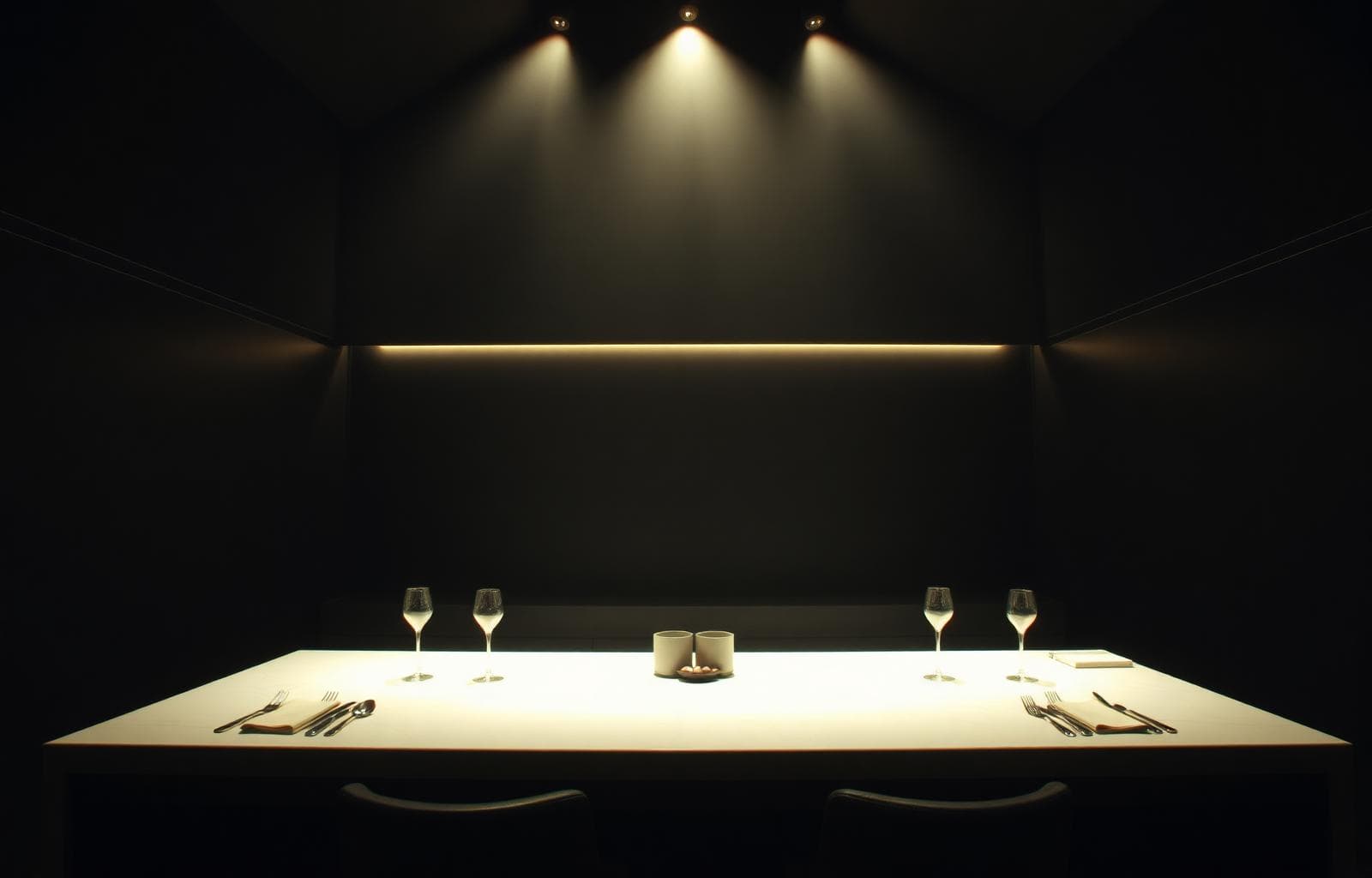
Chapter 1 Introduction: The Restaurant Industry's "Traffic Poison" and Paradigm Shift
1.1 Background: From the Michelin Guide to the Instagram Algorithm
Over the past decade, the global restaurant industry has gone through an unprecedented structural transformation. Fine dining used to build its reputation on long-term commitment to quality, recognition by professional critics (Michelin, Gault & Millau), and organic word of mouth — a slow but durable brand-accretion process. The full saturation of social media — Instagram, TikTok, Xiaohongshu — has produced a new business model: the hard-to-reserve restaurant.
These venues share a recognisable shape: very few seats (often under 15), a high per-head spend, opaque reservation channels (regulars-only or fully booked), and heavy dependence on KOLs (key opinion leaders) for visual amplification. In this model, dining is no longer just gustatory — it becomes social capital: a thing to display and brag about. Through the social-media lens, food becomes a symbol; the screenshot of a successful reservation becomes a token of power.
Early on, this play on information asymmetry and artificial scarcity was wildly successful. Restaurants vaulted into market awareness in weeks, sometimes booked months out before opening. Recently, however, market data, consumer sentiment and a string of operating scandals have made the fatigue of this closed, traffic-dependent model unmistakable — and in places, systemic.
1.2 Motivation: Thermodynamic Entropy in a Closed System
Think of it as a closed loop: a restaurant that stops bringing in new customers and real feedback slowly runs out of energy — the room fills with the same faces, and the business loses its ability to adapt. (new customers, real market feedback) inevitably trends toward higher internal disorder and loses vitality. When a hard-to-reserve restaurant pours all marketing into a handful of KOLs and reserves seating for a closed regulars circle, it builds an "echo chamber" walled off from outside reality.
This study unpacks four core questions:
Diminishing marginal returns on traffic: why does a KOL's pull decay exponentially with repeat exposure?
The mutation of new-customer barriers: how does a reservation mechanism mutate from a supply-demand allocator into a double wall — technical (bots) and social (class exclusion)?
The mutation of the regulars relationship (the "raise–trap–slaughter" pattern): how does the regulars system curdle into price discrimination, emotional pressure and value extraction?
Customer-base stagnation and innovation freeze: how does a homogenised customer base strip a restaurant of its shock-absorbers, leaving it to collapse in any economic dip or PR backlash?
Chapter 2 The Marginal Effect of Traffic: Repeat-Exposure Fatigue in KOL Marketing
2.1 The Law of Diminishing Marginal Returns in the Influencer Economy
2.1.1 The opening dividend, and how trust is spent fast
The first time a credible KOL recommends a new restaurant or menu, their audience — primed by trust and novelty seeking — converts strongly. Marketing ROI peaks here. But trust is consumable. Studies show that as posting frequency rises, marginal audience response decays exponentially [1].
What's underneath is the saturation effect: the first bite of chocolate cake is the best; by the tenth, you're nauseous. When the same restaurant appears across multiple KOL feeds within a short window — same plating, same superlatives ("melts in your mouth", "the best in town") — novelty is replaced by ad fatigue.
2.1.2 Content homogeneity and "banner blindness"
In digital-marketing psychology, users develop banner blindness — they auto-skip whatever their eye reads as advertising. For hard-to-reserve restaurants, where menus update once a quarter or once every six months — far slower than social-media's content burn rate — KOL output drifts hard toward sameness.
When a viewer scrolls Instagram and sees five influencers in front of the same wall, posing the same way, praising the same dish in the same words, the brain instantly classifies it as paid promo and triggers its defence. Research finds that 61% of consumers lose trust in a brand the moment they sense the influencer's persona doesn't fit, or the content lacks authenticity [2].
2.2 The "Filter Bubble" Trap of Algorithmic Distribution
Many operators believe a KOL's follower count equals reach to a potential customer base. It doesn't. Modern feeds privilege "interest-similar, high-interaction" clusters.
2.2.1 The closed loop of information
Long-term reliance on a few mega-influencers funnels exposure into a fixed in-group with high overlap. The marketing dollars are bombarding the same people repeatedly while never reaching anyone new. The phenomenon has a name: audience overlap waste.
2.2.2 The vanity-metrics trap
Operators see big like and comment counts and assume the heat is real. Bubbles hide underneath:
Engagement pods: influencer cliques that like and comment on each other's posts to game the algorithm.
Bot accounts: bought followers and engagement are an open secret in the industry [3].
Useless reach: even when interactions are real, audiences too far away or too low-spending convert close to zero.
This false prosperity hides a collapsed conversion rate, leading operators to keep buying low-quality reach. Customer acquisition cost (CAC) climbs sharply [4][5].
2.3 Audience Psychology: From Envy to Resentment
Early on, KOL check-in posts triggered FOMO (fear of missing out) and pushed audiences to book. But when "hard to reserve" becomes the permanent state, the psychology shifts.
When viewers realise only a handful of KOLs ever get a table, and those KOLs always rate the place 10/10, FOMO flips into relative deprivation: "Why do I pay the same money — sometimes more — and still can't get in?" Unaddressed, that gap turns into hostility, even active boycott [6][7].
Chapter 3 Inside the Walls: New-Customer Barriers and Technical Isolation
3.1 Hunger Marketing Pushed Past Its Limit
"Hard to reserve" is hunger marketing taken to the extreme. By limiting supply, the restaurant tries to lift perceived value and desirability. When that scarcity is overplayed and crystallises into structural unattainability, it stops being marketing and starts being a tumour on the business.
3.2 Technical Walls: Bot Wars and a Reseller Economy
3.2.1 Automated bots monopolise the slots
In a digital reservation era, the biggest barrier ordinary diners face is asymmetry of capital and tech. With the rise of Inline, TableCheck, OpenTable et al., a quiet bot war is on. Professional resellers run scripts that drain prime-time slots within milliseconds of release, bypass CAPTCHAs, fake human behaviour, and even hit the system's back-end API directly. No human, however punctual, can outrun a machine.
3.2.2 Capitalising the reservation right; black markets
The technical monopoly spawned a sizeable secondary reservation market. In Taipei, Tokyo and New York, hot-spot reservations resell at thousand-NTD-plus markups — sometimes higher than the bill itself. Entry now requires not just spending power but also willingness to pay rent-seeking costs. This filters out the price-sensitive middle class and food-loving millennials, leaving only the price-insensitive wealthy and the social-status performers.
3.3 Social Walls: Insider Exclusivity and Information Lockout
3.3.1 Information asymmetry and an invisible class
New customers can't access reservation-window timing, hidden menus, or special-event invites — those circulate only inside private regulars channels (Line groups, WeChat). The asymmetry inflates insider pride and stings outsiders into resentment.
3.3.2 Brand-image fallout
Once a place is labelled "only for influencers", "needs connections to eat at", or "class-discriminating", general perception falls fast. That exclusivity violates the core spirit of hospitality — warmth and respect for everyone who walks in. When the heat eventually fades and the restaurant tries to court a wider audience, it discovers it's already been tagged by the market as arrogant and unapproachable: a brand island.
Chapter 4 Killing the Goose: How Regulars Are "Raised, Trapped, Slaughtered" and Walk Away
4.1 The "Raise–Trap–Slaughter" Pattern
In financial-market slang, "raise–trap–slaughter" describes how big players sweeten the bait, lock retail investors in, then harvest. In a hard-to-reserve restaurant, the same pattern manifests as: bond emotionally, lock in spending habits, then extract value.
Raise Tools: secret reservation lines, chef's special service, KOL photo ops. Psychology: prestige, belonging, social superiority. Goal: build a sticky core circle, an "us" identity.
Trap Tools: bigger deposits, mandatory wine pairings, expensive memberships, social pressure. Psychology: sunk cost fallacy, social pressure, reciprocity. Goal: lock in future cash flow, raise switching cost.
Slaughter Tools: unjustified price hikes, cheaper ingredients, mandatory bundles, marked-up reservation pass-throughs. Psychology: relative deprivation, cognitive dissonance, betrayal. Goal: maximise ARPU before the heat dies; squeeze residual value.
4.2 Price Discrimination and Hidden Inflation
4.2.1 Marked-up "agent reservations" and pass-through fees
In extreme cases, KOLs or veteran regulars who hold reservation power become landlords: charging entry fees to friends or fans, or making them split the KOL's own bill. One reported case: a KOL invited friends to a 2-Michelin restaurant, then asked each to cover an extra meal's worth to subsidise the influencer's own dinner — one guest was charged NT$16,000. Restaurants tend to look the other way because it guarantees full seats and high ticket size. The collusion adds up to a coordinated rip-off of end consumers.
4.2.2 Forced consumption and "allocation" requirements
Mandatory wine pairing: every guest must take a high-priced wine pairing, or no reservation. To non-drinkers, allergic guests, or budget-conscious regulars, that's price intimidation in disguise.
Unreasonable minimums: minimums set well above average bill, forcing diners into high-margin, low-value add-ons (caviar, truffle).
Bundling: pinning unpopular items to popular ones — works short-term, erodes brand value over time.
4.3 Emotional Coercion and Social Hostage-Taking
Regulars systems run on relationships. When operations are weak or a new menu needs pushing, owners lean on personal ties: regulars get asked to buy out the off-peak slot, or to push New Year gift sets to friends. When a regular voices disappointment, the answer is "We're friends, you're not going to back me up?" — making polite refusal hard. Mixing commerce with personal feeling overdraws the emotional account, and the regular slips out quietly after a few too many letdowns.
4.4 Falling Repeat Rates Among Regulars
Regulars are regulars because at some point they got something extra — an experience or value they couldn't get elsewhere. Sustained raise-trap-slaughter turns extra into overpriced. After enough visits, the regular shifts from "let me bring friends" to "let me warn friends off"; once their internal anchor moves from "worth going" to "there's a better place", the momentum is gone — and that move rarely reverses. Acquiring a new customer always costs more than keeping one. A healthy operation is one where existing customers bring more customers and a meaningful regulars share is preserved. See also Using Customer Lifetime Value (CLV) to lift restaurant performance.
Chapter 5 Endgame of Involution: Stagnant Customer Base, Frozen Innovation
5.1 The "Stagnant Pond" Effect of Customer Homogeneity
5.1.1 No real feedback loop, the chef's information cocoon
Inside the in-group, regulars and KOLs preserve their privileged relationship by giving only positive feedback — even ignoring obvious quality slippage. KOLs need to keep up the "tasteful, refined" persona; even when a meal misses, they soften the language. The restaurant loses its real feedback loop. Owner and chef bathe in fake praise and miss what's coming [8]. The information cocoon is the largest enemy of innovation.
5.1.2 The death of innovation: cooking for Instagram
Visual fatigue: every dish is engineered to shoot well; expensive ingredients (uni, caviar, wagyu) get stacked at the expense of technique and flavour layering. Menus calcify; nothing new.
Story fatigue: when the signature dish stops being shareable, KOLs walk to the next target; the restaurant has nothing new to feed them.
5.2 Extreme Fragility Under External Shock
5.2.1 Macro cycle shock
Fine dining is highly macro-sensitive. In downturns or inflation, the middle class cuts non-essential luxury dining first. Without a wide popular base, hard-to-reserve restaurants face a cliff drop the moment their regulars' assets shrink or sentiment cools. Mass-market peers can survive on volume; high-cost reservation venues can't price down.
5.2.2 Backlash chain reaction
In the social-media era, reputation breaks in a moment. Any negative event — arrogant service, hygiene, price gouging, PR fumble — gets amplified, and resentment that's been quietly accruing detonates. Without a broad public base, the restaurant gets little sympathy. The accumulated relative deprivation and hunger-marketing fatigue manifests as "piling on" — the brand crumbles fast. That "everyone pushes a falling wall" pattern is the ripe fruit of long-disregarded social perception.
Chapter 6 Causal Mechanisms: Why It Collapses
6.1 An Out-of-Control Principal-Agent Problem
In influencer marketing the KOL is effectively the agent between restaurant and customer. The KOL's interests (traffic, comp'd meals, persona, paid sponsorships) and the customer's interests (honest review, quality experience, fair price) often conflict. Operators who don't see this — who hand brand voice and even reservation rights to the agent — misalign value. When KOLs over-promise to drive reach, the bill ultimately falls on the restaurant's reputation.
6.2 Survivorship Bias and Faulty Attribution
Operators see a few long-running famous-and-impossible-to-reserve venues and conclude "hunger marketing + KOLs" is the silver bullet. They miss the long tail of places that died fast on hype alone. They commit attribution errors, crediting their own cooking or charisma when in fact the lift was a market dividend, an algorithm tail, and consumer curiosity. When the cycle turns, the same operators stubbornly chant "the food is good, customers will come back" and miss the structural change underneath.
6.3 Wrong KPIs, Blind Spots in Data
Restaurants tend to over-weight vanity metrics:
Wrong: KOL post likes, reach, comment count (easy to fake; easy to mean nothing).
Ignored: CAC, CLV, NPS, share of new customers, return rate (non-regulars), real paid-conversion rate.
Wrong KPIs keep budget pouring into low-yield channels and starve the spend on existing-customer experience and new-customer acquisition.
6.4 Unbalanced Operating Leverage; Rigid Cost Structure
Sustaining the "hard to reserve" mystique requires capping seats — which caps revenue. Sustaining the high-end image requires expensive build-out, top ingredients, large headcount. High fixed cost meets capped revenue: operating leverage is brutal, the break-even line is high. A small drop in foot traffic — KOL fade, table-turn slowdown — flips profit negative immediately. Many "famous" venues look prosperous but run dangerously tight on cash and can't take any wind.
Chapter 7 Cases and a Global View: From Taiwan to the World
7.1 Taiwan: Reservation Chaos and Influencer-Economy Distortions
With Taiwan's tight geography and dense social circles, the hard-to-reserve mess is concentrated and severe. One famous private kitchen was repeatedly accused of monopolising bookings through a few hand-picked KOLs while refusing direct phone or web reservations, then was caught up in a regulars-take-cuts scandal and tax-evasion implications. The fallout: brand goodwill smashed, novelty-seeking diners still trickle in for a while, but the moral foundation needed to become a long-term classic is gone.
7.2 International: Regulation and Backlash in NYC, Malaysia, Japan
USA — New York: New York State passed stricter laws against restaurant reservation scalping. Some hot venues are returning to walk-in only, or reserving large seat shares for neighborhood residents.
Malaysia: Million-follower influencer Khairul Aming opened a high-priced restaurant and explicitly told the public it wasn't affordable, triggering a firestorm. Translating an "approachable" persona into "high-end dining" comes with a cognitive gap and social resistance the math rarely closes.
Japan: Several top sushi houses now ban photography, and even ban influencer visits, to drag dining back from "visual consumption" to "taste consumption".
7.3 What the Failures Teach
Common patterns across post-hype closures:
Ignoring fundamentals: optimising for "Instagrammable" plating at the expense of taste consistency and service detail.
Arrogant service: turning "rejecting customers" into a signal of class, eventually angering the public.
Price drift from value: raising prices into inflation without lifting value, so consumers feel "fleeced" — and online "unrecommend" waves do the rest.
Chapter 8 Strategy: The Path From Closed to Open
8.1 Marketing: From Reach to Trust
De-centralise away from KOLs: shift weight from mega-influencers to micro-influencers and real-customer UGC. Micro-influencers have smaller followings but higher engagement, more trust, and tighter local relevance.
Authentic content: encourage unpolished real experiences, accept some negative reviews, build brand resilience.
Owned media: run your own social accounts and newsletter; talk to customers directly, not through algorithms or platforms.
8.2 Operations: Break the Reservation Wall
Hybrid reservations: hold 30–50% of seats for walk-ins or same-day phone bookings. This dismantles bot dominance and admits new traffic.
Identity verification + tech defence: real-name verification, sensible deposits (not punitive ones), and AI to identify and ban scalper bot accounts.
8.3 CRM Reframed
From transaction to relationship: stop treating regulars as ATMs. Build a transparent, fair membership programme, not a private nepotism club. Reward long-term loyalty and brand affinity, not just one big bill.
Data-driven recovery: with modern POS + CRM, monitor visit frequency and churn. When a regular's frequency drops, reach out with care or a private offer (not pushy upsell), find the friction, fix it.
8.4 Back to Value: Product Is the Only Moat
When the marketing din fades, the restaurant has to come back to first principles — food and hospitality.
Real menu innovation: refresh the menu for taste and ingredient discovery, not for the camera.
Equal respect: same standard of service for the million-follower influencer and for the first-time visitor. Kill double-tier service.
Empower frontline staff: train them to handle KOL pressure, give them authority to take care of the guests who actually matter.
Chapter 9 Conclusion: Cut Through the Bubble, Return to Essentials
The hard-to-reserve crisis is, fundamentally, a violent collision between the digital traffic economy and the spirit of restaurant hospitality. Over-reliance on KOL plus hunger marketing produces volume and revenue fast, but the foundation is sand — information asymmetry, manufactured scarcity, short-termism.
When repeat exposure drives marginal returns to zero, when high technical and social walls block fresh blood, and when the most loyal regulars are bled through "raise-trap-slaughter" and walk away, the closed system trends inevitably toward entropy and collapse. This isn't the failure of one restaurant — it's a stark warning to the whole industry's "traffic-first" worldview.
The future winners won't be the loudest or the hardest-to-book — they'll be the brands that balance digital marketing with real experience, hold tasteful scarcity without becoming exclusionary, and treat every customer with respect. The ultimate moat for a restaurant is trust, not traffic. For operators, now is the time to dismantle the walls vanity and greed have built, return to the public eye and to daily life, and let the water move again.
Appendix: Key Data and Reference Indicators
Table 1: KOL Marketing Decay Model
Launch KOL type: Mega Audience response: novelty, FOMO, high engagement Marginal ROI: high Main risk: high CAC, low audience overlap.
Growth KOL type: Micro Audience response: trust, willingness to try Marginal ROI: medium Main risk: aesthetic fatigue starts to show.
Saturation KOL type: Repeat exposure Audience response: ignore, annoyance, suspicion Marginal ROI: negative Main risk: brand damage, trust capital overdrawn.
Table 2: Traditional Reservations vs. Scalper / Insider Monopoly
Entry barrier Traditional: low (time cost) Scalper/Insider: very high (money / connections / tech).
Customer-base structure Traditional: diverse, fluid Scalper/Insider: single, homogenised, locked-in.
Price transparency Traditional: high (open prices) Scalper/Insider: low (hidden fees, mark-ups, bundles).
Market feedback Traditional: real, immediate Scalper/Insider: fake, lagging (echo chamber).
Resilience Traditional: strong (risk dispersed) Scalper/Insider: weak (eggs in one basket).
🔗 Read more
- Post-Pandemic Inbound Tourism Trends and the 2025 Restaurant Marketing Playbook
- Taiwan Restaurant Industry 2024–2026 Deep Dive: Nominal Growth, Demand Redistribution, and Structural Squeeze
- 2025 Taiwan Restaurant Industry Trends Report
- Best Restaurant Reservation Systems Taiwan 2026: 6 Options Side-by-Side
- Marketing ROI calculator
Was this helpful?